If I had to describe Brandon Sanderson’s works, it would be like frequenting your local five-star escape room business, where every room offers you a distinctive experience, complete with a unique story, theme, and puzzles, yet you always get the sense that the same creative mind is behind every curtain.
Now imagine all those rooms have puzzles and hidden story elements that subtly hint towards some sort of connected continuity with all the other rooms, despite their vastly different themes. This is the Cosmere.
So, for the uninitiated, what is the Cosmere?
Well, it’s a universe, quite literally. Well, more specifically, it’s a universe populated by dozens of planets and solar systems. Many of these planets are barren, however, a select number of them have a “god” (or multiple “gods”) tied to them. These “gods” were once part of a single god, however, a group of sixteen people killed and shattered the god into pieces. Each of them got a “shard” which represents a personality trait of the original god. These “shards” made these people gods in their own right, but it also slowly shifted their personalities to the shard that they held. They would soon disperse to different planets, or create their own new planets, dictating the systems of the planet, creating life, and investing themselves in the very ecosystems of the planet (also known as investiture).
Each Cosmere series/novel takes place on a different planet. Like most escape room businesses, the stories are not directly connected. As such, the reader can start at any series or one-off novel within the Cosmere, and not feel lost.
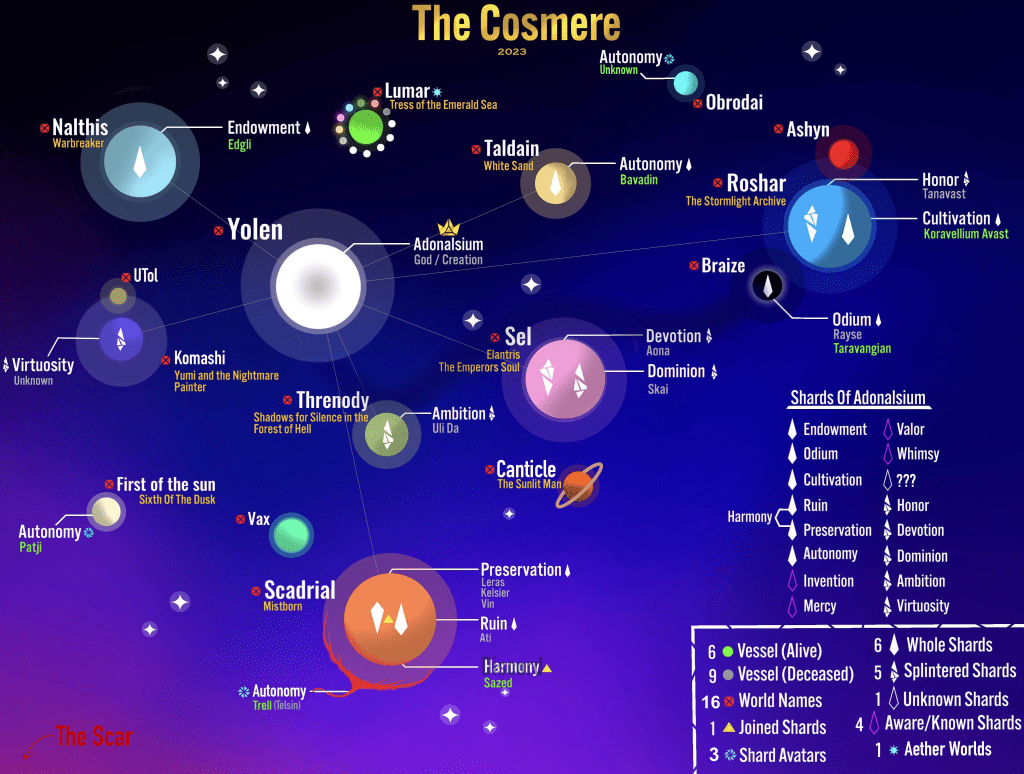
Within the Cosmere, there are three planes of existence: the physical realm, the cognitive realm, and the spiritual realm. Without getting too into the weeds, the distance from one planet to another is immeasurable in the physical realm (at least before technology progresses into space), however, in the cognitive realm, one could simply walk between planets. The only problem? It’s not easy to get into the cognitive realm as a human. As such, each book within the Cosmere will have a few references to other worlds. There may also be a few characters that reoccur between books or may seem out of place. Thankfully, the first-time reader is not expected to understand these references. They don’t need to be understood. In fact, oftentimes, they aren’t meant to be understood in a first read-through.
That is the beauty of the Cosmere. Sanderson writes his novels in such a way that all his systems intricately connect deep enough to allow for analytical-minded folks to chew on, while also providing an engaging story for the casual reader. Sanderson does this while also giving himself enough flexibility to create new stories, worlds, and magic systems without breaking the continuity of what has been built before.
My Experience
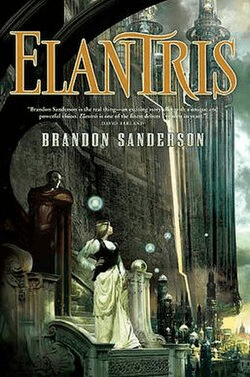
I first entered the world of Sanderson through his first Cosmere novel, Elantris. Many people consider Elantris one of the author’s weaker entries given it was one of his earlier works, however for me, it couldn’t be more of a delightful treat to get me back into the world of books. At the time, having not read a novel in a while, Elantris was my attempt to find something to draw me back into books. Consider it a success.
(Warning: Minor Spoilers Ahead)
Elantris is told from three perspectives. First is Prince Raoden, a man who is next in line for the throne of Arelon and is to marry soon. However, one day, he wakes up to find himself covered in dark splotches and looking disfigured. He had been taken by the Shaod. Once, those who had been taken by the Shaod became glowing figures with incredible abilities. They would move to the glowing city of Elantris to be with others who had the same abilities. However, at some point before the start of the book, disaster struck the Elantrians when their skin turned to dark splotches and their city darkened and began to crumble. Now, those taken by the Shaod are covered with the splotches and locked in the disgraced city of Elantris. Raoden is forced to learn to survive within the city and find a way out.
The second is Princess Sarene, the woman who was to wed Prince Raoden. Upon arriving in Arelon, she is immediately told she is a widow and that Raoden is dead. She soon becomes suspicious of the circumstances behind his “death” and is determined to find out the truth.
Finally, we have Hrathen, a high priest who follows Shu-Dereth and is trying to peacefully (but forcefully) convert the country of Arelon to the religion while avoiding religious conflict.
Throughout the book, the fates of each of the characters increasingly intertwine as the stakes grow higher and higher for what will become of Arelon.
The magic system within this world (the planet, Sel) is called the AonDor. It involves drawing “Aon” symbols using energy from the “Dor”. These symbols give unique abilities like creating objects, healing, and much more. Most of the magic systems within the Cosmere are based around some form of spiritual “investiture” from the god associated with the world.
There is also generally some form of religion within most of Sanderson’s worlds. Elantris is no exception. Within the planet of Sel, there are two major religions: Shu-Dereth and Shu-Korath, both of which derive from Shu-Keseg. There is also a more cult-like offshoot called the Jeskeri Mysteries.
Even in his earlier novels, Sanderson is able to masterfully weave religion in such a way that it does not feel out of place or preachy and is often instrumental in the plot of his stories.
Personally, I really enjoy the way Sanderson intertwines his character-centric storytelling with the world itself. In many novels, the author will either focus on the worldbuilding at the cost of the characters themselves, or they will focus too much on the characters, only using the world as a backdrop/playground for the characters, making the world almost immutable.
Sanderson writes in such a way that the characters take center-stage, where their actions leave a mark on the world while still allowing time for the world itself to breathe. There is a sense that the world is not just a stage for the characters, but an active force that shapes them just as much as they shape it. In many of Sanderson’s stories, there is a clear layer of interplay between the world and the characters.
(Warning: MAJOR Spoilers Ahead)
In Elantris, we discover that the Shaod became a curse because an earthquake reshaped the continent’s landscape. Since the symbols of the AonDor are drawn to mirror the surrounding geography, this shift broke the magic system entirely. The world itself changed, and the characters suffered the consequences. In this way, Raoden’s journey towards discovering and fixing this directly links him to the world, and by extension, the magic systems that dictate it. This really emphasizes the worldbuilding Sanderson has done while keeping the focus on Raoden.
This interplay between the worlds becomes even more apparent in some of the other series within the Cosmere. In both Sanderson’s first Mistborn Trilogy and the Stormlight Archives, we see worlds that are literally crumbling around the protagonists as they do what they can to influence and change the fates of these worlds.
By tying the actions of the characters to their worlds, when a character does appear in another series, it feels like they are bringing a piece of their world to another world. In fact, this is often how the reader can tell there is a character out of place. It isn’t through name dropping (unless it’s Hoid…) but rather through subtle references of dialogue or physics that seem out of place for the series.
Conclusion
Like the escape room, Elantris is only one experience of many. If you’re looking for a story epic in scope, the Stormlight Archives is the way to go. If you’re looking for a more contained, but high stakes story, Mistborn is the way. Each of these series is their own unique experiences, but in one way or another, they are all connected, whether through the Cosmere or by Sanderson’s unique storytelling. All in all, I encourage you to step into a room and experience it for yourself!


Leave a Reply